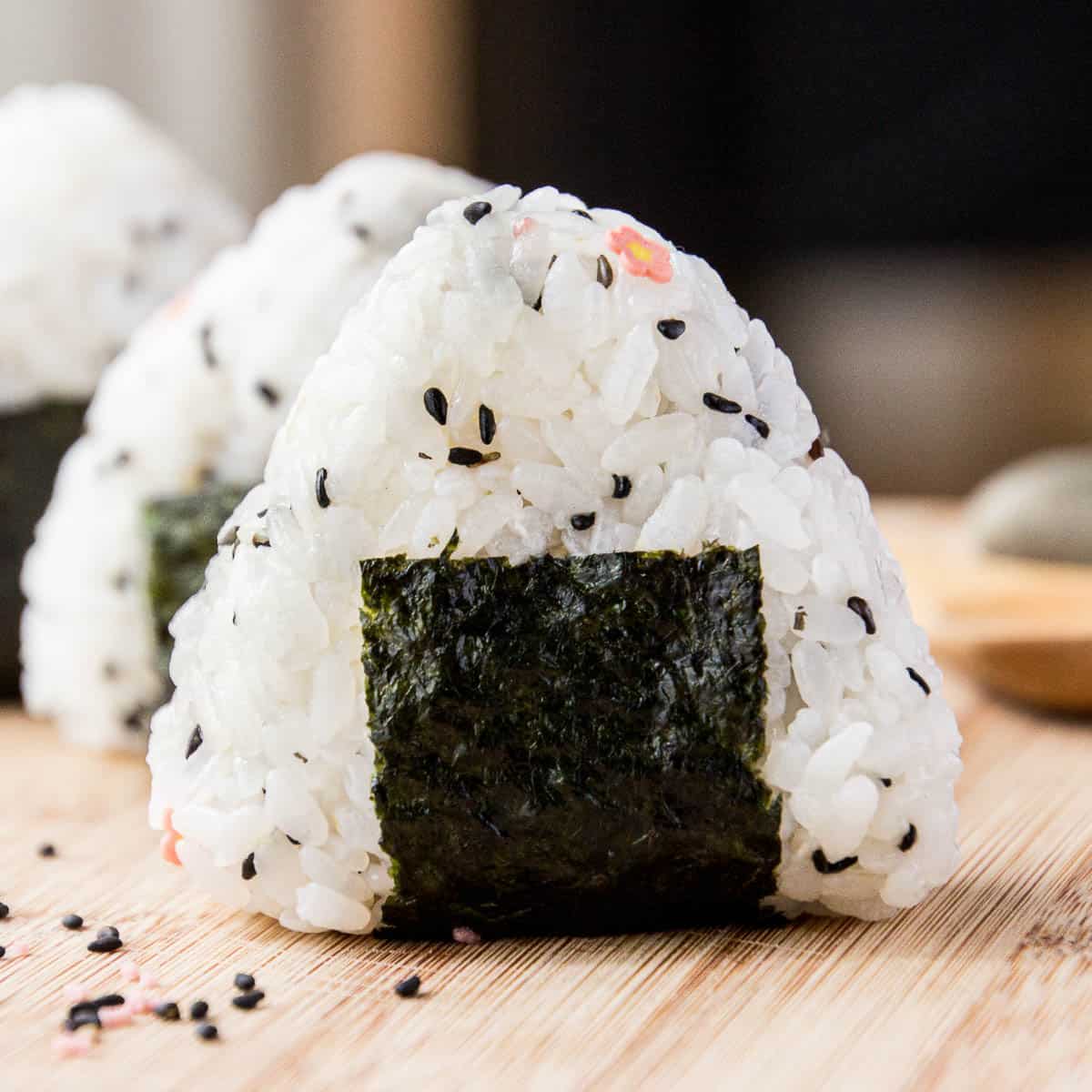
ONIGIRI


Onigiri (お握り or 御握り), also known as omusubi (お結び)nigirimeshi (握り飯), or rice ball, is a Japanese food made from white rice formed into triangular or cylindrical shapes and often wrapped in nori. Traditionally, an onigiri is filled with pickled ume (umeboshi), salted salmonkatsuobushikombutarakomentaikotakanazuke (pickled takana, Japanese giant red mustard greens) or any other salty or sour ingredient as a natural preservative. Most Japanese convenience stores stock their onigiri with various fillings and flavors. There are even specialized shops which only sell onigiri to take out. Due to the popularity of this trend in Japan, onigiri has become a popular staple in Japanese restaurants worldwide.

Despite common misconceptions, onigiri is not a form of sushi and should not be confused with the type of sushi called nigirizushi or simply nigiri. Onigiri is made with plain rice (sometimes lightly salted), while sushi is made of rice with vinegar, sugar and salt. Onigiri makes rice portable and easy to eat as well as preserving it, while sushi originated as a way of preserving fish.

taken from: https://en.wikipedia.org/wiki/Onigiri

Comments

Popular posts from this blog

INFO MAHASISWA BARU

  INFORMASI MAHASISWA BARU Syarat Pendaftaran Calon mahasiswa STIBA-IEC Jakarta adalah lulusan SMA/SMK/MA dari semua jurusan Mengisi dan menyerahkan formulir pendaftaran dengan melampirkan:  Satu (1) lembar fotocopy ijazah dan daftar NEM SMU/SMK  yang telah dilegalisasi. Satu (1) lembar Fotocopy KTP dan KK. Empat (4) lembar Pas foto berwarna  ukuran 3×4 cm. Mengikuti tes penerimaan Mahasiswa Baru Waktu Pendaftaran PEMBUKAAN DAN TES MASUK Gelombang 1 (November 2022 – April 2023) Tes masuk tgl. 29 April 2023 Gelombang 2 (Mei 2023 – Juni 2023) Tes masuk tgl. 24 Juni 2023 Gelombang 3 (Agustus 2023) Tes masuk tgl. 26 Agustus 2023 Tes Potensi akademik (Numerik,Verbal,Analisis). Tes Masuk meliputi: Bahasa Inggris Tes dilaksanakan pada hari sabtu Pendaftaran dibuka Senin s.d Jum’at : 08:00 – 20:00 WIB Sabtu                        : 08:00 – 17:00 WIB Segera hubungi: Telp.021-8518685 SMS/WA: 0856-9540-0674 (Ms. Teeny)...

TRAVELING

What is traveling? Travel  is the movement of people between distant geographical  locations . Travel can be done by  foot ,  bicycle ,  automobile ,  train ,  boat ,  bus ,  airplane ,  ship,  or other means, with or without luggage, and can be one-way or round trip.   Travel can also include relatively short stays between successive movements, as in the case of  tourism . Reasons for  traveling include  recreation ,  holidays, rejuvenation,   tourism  or  vacationing ,   research  travel,  the gathering of information, visiting people,  volunteer travel  for  charity ,  migration  to begin life somewhere else, religious  pilgrimages ,   mission trips ,  business travel ,   trade ,   commuting , obtaining health care,  waging or  fleeing war , for the enjoyment of traveling, or other reasons. Travelers may use  hu...

KETOPRAK

Ketoprak  is an  Indonesian  food  vegetarian  dish from  Jakarta , consisting of  tofu ,  vegetables ,  rice cake , and  rice vermicelli  served in  peanut sauce . The etymology of the name  ketoprak  is actually closely related to  Javanese folk-drama . During the  Great Depression  in 1930 - 1931, ketoprak viewership was dwindling. Djojosoekarno, a member of Javanese ketoprak troupe "Langenhardjo" in  Jakarta , started selling a dish made of  tofu  mixed with  bean sprouts  and  sweet soy sauce  on stalls for extra income. Due to his popularity as ketoprak performer, customers usually referred to him as "Bang Ketoprak" (lit. "Mr. Ketoprak") and as time passes, his specialty dish is known as ketoprak on itself. taken from: https://en.wikipedia.org/wiki/Ketoprak_(dish)